Thursday, December 29, 2005

Race relations today

Via Instapundit this morning I learned that America might have one of the first instances of black people infringing on the voting rights of white people.  Only in Alabama.

      Using the 1965 Voting Rights Act, the government has alleged that Brown and local elections officials discriminated against whites. It is the first time the Justice Department has ever claimed that whites suffered discrimination in voting because of race.

Brown thinks it’s politically motivated and that the Justice Department is in league with the Republican Party.  Although one of the witnesses is a Democrat.  He’s white, however, and alleges that Brown imports black candidates from out of county to run for offices against white Democrats.

      The president of the Mississippi NAACP, Derrick Johnson, says there is still plenty of discrimination against black voters in the state, and he questions the Bush administration's priorities in bringing this suit.

      "We've had several issues over the years of what appeared to be racial discrimination against black voters and the Justice Department has yet to come in and do a thorough investigation," Johnson said. "And for them to take on this case is highly unusual and very suspect."

I think that Johnson might be right about that.  I know that there is still discrimination against black people in this country, although nothing like 30 years ago, and he perhaps there are dubious motivations surrounding the Justice Department’s case.  However, if Brown IS in the wrong here, two wrongs definitely don’t make a right, and if you really want to make a point, Mr. Brown and Mr. Johnson, please prove that you are better than the white racists by proving that you are not racists yourselves.

Making lawsuits harder

A judge ordered environmentalists to pay a bond in order to delay logging on a plan in Montana.  Justification is that it will help prevent suing legal logging operations in order to drain the coffers of the logging companies.

      The National Forest Service did a full environmental impact statement on this logging proposal.  Since then, the environmental groups in question have gotten a couple of restraining orders while the courts considered, then rejected their complaints.  Now after spending considerable time and money fighting this "hazardous fuels reduction project," the environmental groups claim they don't have the money to post the bond to stop this "illegal" logging. 

I think it’s obvious what the tactic of the environmental group is here, and this kind of thing happens in Oregon all the time.  I’m not surprised that environmental minded groups are not happy with this verdict, as they aren’t typically interested in what the legal system has to say to them.  I wonder if this verdict, in making it very hard for them to use the legal system in the only way they know how, will make lawless protest activity more frequent.

Oregon State politics

Roguepundit noted that Oregon partisans have learned to work together.
If it means helping the to keep them in power.

      Partisan politicians who run as independents will need to get nominating signatures from nonaffiliated voters or those who don't vote in the primary, said John Lindback, the director of the state Elections Division.

      Which is trying to prevent another Ralph Nader situation where Democrats accused Republicans of signing petitions to get him on the ballot just in order to suck liberal votes away from the Democrats.

However, I think that this will only hurt the democratic process in the long run.  Nice job, Oregon representatives.
Oh, yeah, and another thing: while government officials are complaining about large corporations not funding their pensions or stealing money from them, do you think they could clean up their own act and learn how to fund their own?  (That one also brought to you from Rogue)

Albuquerque, in sum

Vacations can be fun, relaxing and food for the soul.  The one I took last week is no exception.  I did a good part of my growing up in Albuquerque, New Mexico, a very dry place, only to spend the better part of my adult life in Portland, Oregon.  The contrast is striking.

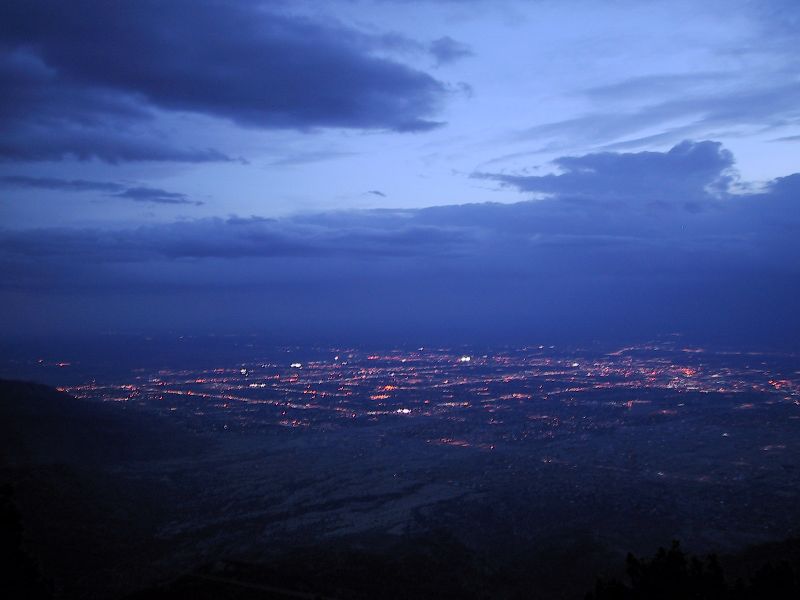
Here’s a great picture of Albuquerque at night from the top of Sandia.
Here are some other photos.  I regret that I don’t have many myself, as they are almost all personal and involve unwrapping presents and such.

Getting back there is always a treat.  Some parts remind me of my childhood, but since my parents moved out of our southeast middle class neighborhood and into the heights near the mountain, I’ve found that I spend almost no time in the old haunts any more.  I really can’t “go back home” as the saying goes.  But home is where the heart, or the family, is, and so my parents new place is home enough when I’m there.

Albuquerque, for those of you who imagine that it never gets cold, is often below freezing in the winter, and does get snow every winter, although not much.  It’s at 5,500 feet (over 6k at my parents place) and sits in the middle of the continent.  The skiing is powdery and dry, but the ski area on Sandia, the peak over Albuquerque, is hard pressed to get enough snow to open some years.

However, this year it was quite warm in New Mexico while we were there.  If you can’t have a white Christmas, why not have a warm and sunny one.  There were a couple of days I decided shorts and a light sweatshirt were quite enough to run around doing errands with.

While there I also make a point of eating lots of New Mexican food drenched with green chile.  No, I didn’t spell that wrong.  Chili is the sauce you serve with beans and usually comes in a can con-carne.  Chiles are what you call the peppers down there.  The green and red chiles used in New Mexico are often used in place of other sauces in dishes.  My favorite enchiladas come covered in chile instead of some enchilada sauce, and are served flat instead of rolled.  Chile Rellenos are a popular dish, as is green chile stew, and huevos rancheros (eggs) are made with green chile instead of salsa. 

By the way, cilantro is an herb that originated in Asia, but was imported when Europeans started coming here.  New Mexicans cook dishes that have histories dating back hundreds of years, and I didn’t taste one leaf shred while I was down there.  I generally disagree with putting cilantro or heavy amounts of herbs in Mexican cooking.

Sopapillas are served with most meals, as readily as rolls in American-style restaurants, and are deep fried so that they puff up instead of stay flat like Mexican Sopas (and don’t roll them in cinnamon/sugar).  You tear them open, put a little honey in them and eat them after the main meal to subdue the spices from the chile.  You can’t get them made that way up here, at least I don’t ever see them, so I crave them when down there.

I don’t often get down there for this, but if you are in the area in October, Albuquerque hosts the worlds largest hot air balloon festival.  Since you can see most of the city from basically anywhere in the city (as a result of the geography) watching can be an anywhere-in-town experience and is fantastic to behold, although being at the launching grounds is the coolest.

I’m back in Portland now, and blogging should resume at it’s normal pace after the new year, so stay tuned.

Wednesday, December 21, 2005

When the cows come home

I’m taking the week off.  Anyone reading this who doesn’t know me personally should know that when I take vacations, I don’t browse, google, blog, or pay much attention at all to the outer world.  I just relax.  I’m taking a trip down to the land of my roots.

Actually I just did most of my growing up in Albuquerque, New Mexico, but was born and spent a little of my toddler life in the east.  But I consider the Duke City the home that I left when I became an adult, so I make the pilgrimage there every once and a while and hang with the folks and my sisters.  Usually every other Christmas at least.  We put up some luminarias (or farolitos if you like), play hearts, eat excellent New Mexican food and catch up.

Have a Merry CHRISTmas and may God see to it that your new year is better than the last one.  Laters…

Partisanship for Kiddies

I saw this article in the Oregonian today.  It seems that some want to shower their political mania on kids

      That's why this holiday season we have books such as "Why Mommy Is a Democrat" and "Help! Mom! There Are Liberals Under My Bed!"

Please!  Freaks, please leave the children alone.  Let them grow up thinking the world is a wonderful, magical place.  They’ll figure out the rest all too soon on their own.

A reader noted that the article brings up Bill O’Reilly’s book “The O’Reilly Factor for Kids” as an example of a conservative writing a political book for kids, but if the author had bothered to research the book a bit, he would note that this book had very little to do with politics, but was O’Reilly trying to educate kids about growing up and what to expect.  Not that he really has the background for that kind of thing, ala Bill Bennet or something.  More lazy reporting.

Darfur update

Just in case you were wondering:  No, things aren’t getting any better in Darfur, Sudan.  Things seem to be getting worse, and the African Union “peacekeepers seem to be getting their operating instructions from the UN, meaning that they aren’t keeping any peace, just protecting foreigners.

Professor Eric Reeves has been arguing for NATO intervention, and I have made noises like that myself for a while now.  He also has a couple of great maps of the region.

Amendment madness

I would like to continue my non-partisan gripe, soon to become a crusade, about congresspersons who attach bills or amendments onto larger legislation because the larger bill is certain-to-pass, and their amendment might not get consideration otherwise.  I think this is not an ethical practice, even though it seems to be fully allowed and encouraged by practically everyone. 

How many times has a good or necessary bill gone down in flames because of some ultra-controversial rider, or how many bad laws and allocations of taxpayer’s money have ridden on widely supported bills?

Just to show that, despite my conservative bent, I don’t play party favorites on this point, I would like to declare shame upon Senator Ted Stevens (R-Alaska) for trying to attach the ANWR drilling bill to the latest military budget bill.  That bill has money for hurricane relief, and, I’m sorry, but ANWR has nothing to do with military or relief budgets.

      But Stevens, who has fought since the 1980s to pry open ANWR, indicated he would not give up easily.
      "I want you to know we're going to be here until (New Years Day) ... We're going to stay here until this is finished," Stevens said just before the vote. "I can't go home for Christmas. I've already canceled (airplane tickets)."

Do I think the ANWR bill is a good idea?  Sure.  Do I think that environmentalists are talking out of their hindquarters about the impact of drilling.  Yes, I do.  However, I think that holding his colleagues in session for Christmas will get him no more clout or support on Capitol Hill, nor will it get him any kudos from me.

Tuesday, December 20, 2005

NSA ramblings

I have only glossed the surface in reading about Bush’s NSA snooping scandal, which is looking less like a scandal and more like a low level debate about accountability of intelligence gathering during wartime.

However, in reading this 60 minutes transcript from February of 2000 regarding the subject (and, as Glenn Reynolds notes:  note that date.  It’s not just Bush), where Steve Kroft interviews an ex-spy, I am more concerned for the intelligence of the analysts reading the conversations.

      Q: Is it possible for people like you and I, innocent civilians, to be targeted by Echelon?
      Mr. FROST: Not only possible, not only probable, but factual. While I was at CSE, a classic example: A lady had been to a school play the night before, and her son was in the school play and she thought he did a--a lousy job. Next morning, she was talking on the telephone to her friend, and she said to her friend something like this, 'Oh, Danny really bombed last night,' just like that. The computer spit that conversation out. The analyst that was looking at it was not too sure about what the conversation w--was referring to, so erring on the side of caution, he listed that lady and her phone number in the database as a possible terrorist.

Really?  As an intelligence analyst, you listened to some conversation a mom was having about her son and that translated: terrorist?  Yikes, I’m more afraid of the CIA than ever.

I note that later in the show, they interview European Parliamentary members about their concern that the US is using the information they get for American industry.  Which to me, just sounds like sorry loser ranting.  Take it to court, and win, and then I’ll take that whining seriously.

Goalkeeper

The American goalkeeper most likely to play in the World Cup this year is former University of Portland keeper Kasey Keller.  He has been playing in European leagues for the last 15 years, and has gotten lots of respect from foreign players and coaches.

A few quotes:

      Keller now plays at Bundesliga club Borussia Moenchengladbach, where he is so highly regarded the notoriously critical German fans unfurl banners praising "Kasey 'The Wall' Keller."

      He is rated second in the league among goalkeepers, ahead of the likes of Bayern Munich's Oliver Kahn, a two-time world goalie of the year.

      Keller had a 15-shutout season for England's Leicester City in 1997-98 and 77 saves for Tottenham two years ago, second best in England's top league. His four shutouts in four UEFA Cup rounds boosted Rayo Vallecano of Spain into the quarterfinals in 2001. The two years he spent with the club make him the only American to play in Spain's La Liga.

      Keller's performance in the Americans' 1-0 win over Brazil in 1998 prompted Romario to say it was the greatest performance he had ever seen by a goalkeeper.

Keller started in England in 1990, where he was the first US player to play there on a US passport.  His presence in Europe opened the door for young American players careers abroad.  I thought he was going to get the nod for the 2002 World Cup, but Brad Friedel got it instead.

Friday, December 16, 2005

Don't leave your CD in the light

For those of you who read this blog regularly, this post is a slight departure from the usual.  I don’t normally talk tech, but have to know some of this stuff for the work I do.  The other day I had to learn about the manufacture and components of CDs and DVDs while trying to figure out why our old method of archiving data on CDs wasn’t working.  The CDs were corrupt and producing the error “Cyclical redundancy” from Windows.  If you have ever seen that error, or just like to learn about stuff, this post is for you.

The first thing you’ll need to understand is that there is a difference between CD-ROM technology, which is what you get when buying music CDs or Movie CDs that were produced in the factory, and CD-R, which is what you buy when you want to copy music or data at home or the office.

The above links explain the manufacturing process of both in a quick and simple manner, but for even more brevity, I’ll compress it even more.  The main difference between the two is that CD-ROM disks only contain three layers: a clear polycarbonate layer, which is etched; a reflective aluminum layer; and a lacquer coating (which is the top where the label is commonly printed).  The data is stamped onto the polycarbonate, all at once, so that the microscopic groove contains pits and lands that are interpreted by the laser as 1s and 0s (that’s too simple, but the explanation isn’t necessary for understanding disk manufacture). 

CD-R disks that you buy in the store have several layers, including a non-etched layer of clear polycarbonate, a dye surface, a reflective layer (gold or silver), a lacquer and a label coating.  The dye surface is a metallic dye like Cyanine or Phthalocyanine, which is actually burnt (or melted) when the drive’s laser strikes the surface of the dye layer.  The burn or melted marks simulate the pits on a CD-ROM and can be read by any drive that reads CD-ROMs. 

The reason this is important is that when you copy CDs at home, they will not last as long as CD-ROMs.  Especially if left out in the light too often.  When left out in the open, light degrades the dye over time, so that eventually the pits become faded, and the CD drive reading the information will get confused and render the error I spoke about above.

This brings up an interesting point.  It has been a part of digital lore among us common folk that copying data, or music, to a CD would completely replicate the sound and therefore be identical to the original.  Whether you believe that this is true or not, one thing is certain, and that is that music made industrially by stamping, like all the stuff you buy at Music Millennium or Tower Records, will last you for years, perhaps decades if you take good care of it.  The etched data on those CDs is made of metallic substances and does not degrade when exposed to light.  Look over your music collection and insert the oldest one into your stereo and it will most likely work, if there aren’t too many deep scratches in it.  My oldest CD is probably almost 20 years old. 

However, CD-R are only designed to last about 2 or 3 years.  A CD-R I inserted in my drive just the other day and got the cyclical error was 2 years old.  If you leave it out in the open more it could last even less time than that.  So the product you get from whatever big music media giant production company is actually superior to what you could produce by copying someone else’s CD for your own personal use, and perhaps worth the money if you care about keeping the music you acquire for a long time.

However, with the advent of IPOD and related devices, that may no longer be true.

Thursday, December 15, 2005

World Cup talk

 I’ve been reading some of the talk from the coaches of the National teams that are competing in the World Cup this summer, and their reactions to the draw.  I’m amused.

Some countries realize how lucky they are considering some of the groups contain relative cupcakes.  Group A, for instance, with hosts Germany: “It could have been worse.  We think this group is very doable.”  Poland: “I think our chances have risen.”  They know they got a sweet draw.

Group D, Mexico: “This is a favorable group, one you can compete in.”  That’s an interesting statement coming from a top seeded team.  But they have to realize that they lucked out getting seeded over the U.S. and have to be thankful they didn’t get put in a group like we did.

Most of the lower seeded teams sounded like they were just hoping to play some good soccer.  The responses from Group C caught my eye.  Ivory Coast: “I think this is the toughest one.”  Serbia: “Easy groups do not exist at the World Cup.”  But they could have said that about any group, at least at their skill level, they wouldn’t have much of a chance in any of the groups, let alone one with Holland and Argentina.  However, in case anyone is looking, the group of death is still group E.  Ghana: “Every team will be difficult, but we like challenges…”  At least Ivory Coast and Serbia will get to play each other.  Poor Ghana will be lucky to score and will probably be on their heels in all three games. 

On playing Sweden in Group B, Sven Ericsson:  “It seems to be our destiny to play them.”  (England played Sweden in group last Cup as well).

Of course I’ll be rooting for the US of A this summer.  I’ve always liked watching England and Sweden play, but this year I’ll be rooting for upstarts Trinidad and Tobago, most of whom play in the English leagues.  Stern John used to play in the US.  Said goalkeeper Shaka Hislop: “I am buzzing.  I’ve spoken to all the players based over here and we are looking forward to it.”

I also liked Australia’s joy at just being there: “This is what dreams are made of.”

Offensive Democratic Sticker

A good friend just Emailed me that the Democratic Party website in Washington State was offering a metallic bumper sticker that attacks Christians using a variation of the “Fish” that you see on so many cars.  Here is the original page, which has been removed, although the state organization has not apologized for putting it there in the first place. 

There are other “ribbon” type magnetic stickers too, with more liberal type statements like “Blue State Pride” and “Support our Environment” which, even though they are a rip off of the original support our troop stickers and other things, I think that’s fine.  The anti-Christian one is quite offensive, and to me is just another example of how un-tolerant the Democrats are becoming.  This is ironic since one of the stickers on this page says “Support Diversity.”

Gender gaps and non-wedlock births

Interesting pulling together of numbers.  Richard Bennett compares the numbers on the growing gender gap in American Universities and the out of wedlock birthrate among different ethnic groups and finds that they correlate very closely.

      But why do Asians do so well in higher ed? One reason is family structure. The out-of-wedlock birth rate for Asians is 15%; for whites it’s 29.4%, for Hispanics it’s 45%, and for Blacks it’s 68.2%. The higher the OOW birthrate, the greater the gender gap in higher ed.

Bennett also noticed that the percentage of Asians entering Berkley rose dramatically when California banned Affirmative Action and they removed the Asian quota on enrollment.

Wednesday, December 14, 2005

Totten in Egypt

Michael Totten is describing his journey to Cairo, Egypt, in great detail.  He is comparing it to Beirut, where he has been living for a couple of months now.

It’s totally worth reading, but he’s not done yet, check his site for the next few days and get the rest.

Sporty Anecdote

They say that sports imitates life.  Perhaps in the sense that we take all our frustrations, our hopes, our aggressions and emotions and frequently pour them out into professional and amateur sports.  We create heroes and demons to root for or against.  We fixate on the beauty and complexity of each sport’s machinations.  Strategy and tactics are like armies fighting battles in wartime, and each team like the troops of some free and democratic nation, battling for victory over a field of other free and democratic (but antagonistic?) nations.

At other times, though, the mirror into our society that high profile sports becomes does not reflect well on us.   Recently, or not so recently, Olympic track and field stars have been accused and often penalized for taking performance enhancing drugs.  Now, I know we can all get confused by this because these drugs are commonly not illegal in the real world.  But it’s felt that they give unfair advantage to people who prefer to compete with what God gave them.  And so the powers that be in the sporting world put tight reigns on what drugs athletes can use, much like our government restricts the use of drugs they deem dangerous to society.

Like in the real world with illegal drugs, sports have legal systems that try and punish athletes who abuse the regulations.  Recently, two sprinters for the United States, Tim Montgomery and Chryste Gaines, were handed two year suspensions for using prohibited substances.

      This is not a defense of Montgomery or Gaines. The Bay Area Laboratory Co-Operative steroid scandal showed the dark side of a win-at-all-costs mentality adopted by seemingly upstanding athletes. Odds are good that Montgomery and Gaines were lured by a competitive advantage in a syringe.

      At issue here is the dangerous precedence set in determining their guilt.
      Lacking actual positive drug tests, USADA went after Montgomery and Gaines for what it called "non-analytical positives" -- evidence without a smoking gun. The arbitration panel found that evidence to be "strong, indeed uncontroverted."

So, the USADA was trying to set a precedent, going after two people highly suspected of taking enhancements, and showing the rest of the athletes under their umbrella what testing positive will get you.

But Montgomery and Gaines were never tested positive for anything, and testimony was largely based on the testimony of another athlete who was also suspended, but is only serving that suspension (instead of lifetime ban for two incidents) because she promised to testify against other athletes.  Does that make the case sufficient to establish guilt?

I like the Biblical precedent of the necessity of at least two people to establish witness against another person.  But the USADA’s use of a single, fairly un-credible witness is proof that they were only trying to get some shred of verification of the story they already believed was the truth.

I see this attitude in society at large.  Perhaps it hasn’t totally worked it’s way into the judicial system proper.  You will most likely get a fair trial because of the rule of law that has guided this country since it’s founding.  But people too often make judgments before evidence is presented.  Politicians pontificate on subjects that are beyond their understanding and make policy with only the thinnest of factual support for their platforms.  Or with none at all.

Tuesday, December 13, 2005

Gerrymandering in the news

So the Texas redistricting issue is now going before the Supreme Court.  I leave it to you, the reader, to peruse the article, look on Google, pick up your newspaper, whatever, and get the bulk of the story.   Quick context is that the state Republican party wants to redraw the districts in a non-census year (which is when you would normally do it) and the Democrats are taking this up the fish ladder, all the way to top, claiming that the redistricting will favor Republicans heavily, and therefore is partisan and wrong and unconstitutional.

But this is a long standing argument about gerrymandering that caused the Texas state Democratic party to exile themselves, first in New Mexico and then in Oklahoma, in order that the state senate would not have a quorum, and therefore could not vote on the redistricting plan.  At it’s very essence, it’s a partisan battle to decide who controls the House of Reps next year.  The difference between the way districts were drawn in 2002 and today, and with the Republican plan, makes or breaks several legislative campaigns for either party.  Does anyone think that either party is speaking totally truthfully?

Of all the articles I’ve read, none pick up why this became an issue in the first place.  Of note, before 2002, the primarily red state of Texas was for some reason still electing a lot of Democrats to the US House.  Why is that?  Exactly, extreme gerrymandering was already in place!  The Republicans effort here should be considered as it is:  a move to eradicate bad districting in the state of Texas.

However, I haven’t seen the re-districting.  It may be that the Republican plan is just as bad, only in the other direction.  It is possible to draw districts so that large areas of your opponents supporters are diluted into your strong areas until they just don’t have a majority anywhere.  So It’s possible that the redistricting does dilute the voting power of minorities.   But the question is:  are the minority populations of Texas getting their voting rights purposefully stomped on by the Republicans, or are their districts just getting less potent because they were heavily gerrymandered in the first place, giving them a disproportionate amount of voting power?

Here’s a better article, and since it’s coming from Texas, it has better information.

World Cup draw

I’m a bit late by this one, as it happened on Friday.  I saw the draw on TV, but you have to be a real fanatic fan of soccer to retain your interest through that entire program.  The announcers, the Irishman Tommy Smith among them, sat and pondered the possibilities for England and the US for about a half an hour, and then the draw took the rest of the hour. 

The draw consisted of a proper Englishman as MC, and a host of soccer legends, like Pele and Johan Cryuff, picking team names out of a bowl.

Basically, the results of that draw have produced a group of death.  Here’s the draw.  The United States happens to be in that group of death this year.  The US has to fight it out with Italy, the Czech republic and Ghana just to make it out of the first round.  Our chances are bleak. 

However Ives Galarcep has a more positive take on this.

      Rather than dreading the worst-case scenarios and imagining a result similar to World Cup 1998, when the United States went winless and finished in last place, American soccer fans should be relishing the opportunity their team has to make a statement. World Cups are about memories and triumphs that endure.

If the US were to get out of that group alive, they would most probably be matched up with Brazil.  Talk about making a statement.

Payback

Senator Coburn is being denied his ability to practice medicine (he delivers babies) by the Senate saying that he is receiving “compensation for practicing a profession which involves a fiduciary relationship.”  He hasn’t been generating any profit from that activity, which basically means that he can’t keep current on his license, since he has claimed that he only intends to serve in the Senate for two terms.  He needs to keep current so he can go back to being a doctor afterwards.

Note that many of the Senators opposing him are upset by his anti-pork crusade. 
Hat tip to Instapundit.

Friday, December 09, 2005

How your charity money is spent

I received this Email from a friend.  Not sure where the data comes from, or if it's fact, but if it is, it's interesting, and it will influence my decision where to send money next time the disaster bug bites humanity.

    As you open your pockets for yet another natural disaster, keep these facts in mind:

    - Marsha J. Evans, President and CEO of the  American Red Cross... salary for year ending 06/30/03  was $651,957 plus expenses.

    - Brian Gallagher,  President of the United Way receives a  $375,000 base salary, plus numerous expense benefits.
    - The Salvation Army's Commissioner Todd Bassett receives a salary of only $13,000 per year (plus housing) for managing this $2 billion dollar organization.

    No further comment necessary.