Tuesday, May 16, 2006

Bush's Immigration Speech

OK, ok. I was not sure if I was going to comment on the President's speech yesterday. So many things have already been said from all sorts of people. However, I will throw in my two cents and hopefully say something that hasn't been said before.
President Bush scheduled his speech for Monday to coincide with the start of major debate in both houses this week on the Illegal Immigration issues at hand. If you didn't catch the speech, you can get a transcript here, or you can actually download and watch the speech from here.

I thought it was pretty good. Not Bush's best speech by a long shot. Some of his early State of the Union speeches were much better. But he said things that he's needed to say for a long time.
Some thoughts on the points he talked about.
1. Increased border security. Amen, brother. As much as I haven't really been impressed with the President's response to this issue up to this point, this is the most important part of the debate. Finally, we're hearing something that resembles sense on national security regarding our borders.
Tonight I am calling on Congress to provide funding for dramatic improvements in manpower and technology at the border. By the end of 2008, we will increase the number of Border Patrol officers by an additional 6,000. When these new agents are deployed, we will have more than doubled the size of the Border Patrol during my Presidency.
At the same time, we are launching the most technologically advanced border security initiative in American history. We will construct high-tech fences in urban corridors, and build new patrol roads and barriers in rural areas. We will employ motion sensors … infrared cameras … and unmanned aerial vehicles to prevent illegal crossings.
Will this stop the influx of desperate men and women, doing whatever they can to enjoy the prosperity they could only dream about in their countries of birth? Perhaps. Anyway it's a step in the right direction. You can't even talk about trying to deal with the massive population of undocumented immigrants in America without putting your finger in the dike that separates out fine land from the rest of the world.
If nothing else you can't argue that Bush hasn't really been tough on border security, as the agency has 50% more agents than it did when he started. However, since 9/11, how many people in his position wouldn't have increased that number.
Also, Bush lays down that there will no longer be "Catch and Release" because of overfilled immigration prison space. Great, but kind of late. This program should have been terminated on September 12, 2001.

2. Guest worker program. Bush claims that creating a program that allows more people to come over for just the sake of taking jobs that other Americans won't take will reduce the number of people trying to sneak over illegally.
A temporary worker program would meet the needs of our economy, and it would give honest immigrants a way to provide for their families while respecting the law. A temporary worker program would reduce the appeal of human smugglers– and make it less likely that people would risk their lives to cross the border. It would ease the financial burden on state and local governments, by replacing illegal workers with lawful taxpayers. And above all, a temporary worker program would add to our security by making certain we know who is in our country and why they are here.
I'm not saying that this wouldn't work, or wouldn't cause problems, but I understand why he's suggesting it. The major complaint here is going to be that other immigrants who are on track to be citizens are going to be upset, as they are trying hard to do things the lawful way while others are being allowed to skirt the law.
And anyway, we've tried temporary worker programs before. (Hat tip to Powerline)
The problem is that we have unsuccessfully tried this approach before, from 1942 to 1964, with the so-called braceros -— the hired "arms" from Mexico. Various programs to bring Mexican laborers across the border were initially small, supposedly temporary and aimed only at alleviating wartime shortages of labor.
But some 4 million braceros later, the idea of guest workers had evolved into a huge labor exchange, delivering hardworking,— and very cheap, farmworkers to American employers, most of them large agribusiness concerns.
And the current Senate plan is inviting an influx of immigration that could overwhelm the system.

3. Greater employer accountability and harder to fake documentation. Mostly I'm with him here, except that there's really no pressure on employers now, so "more" enforcement or accountability is relative.

4. No amnesty, but no mass deportations. We all realize that trying to deport all the people currently here illegally isn't practical, and certainly most people are sensitive to the realities of those people's lives. The places they would have to return to, and the families and lives they have developed here.
Bush is sending a message here, I think, to the Senate, whose plan (see above) calls for some of the undocumented workers who have been here over 2 years a path to citizenship. Which is amnesty.

5. Assimilation and English as the language that immigrants must learn to become citizens. This should be a no-brainer, and yet so many public and government signage and documentation is displayed in Spanish as well as English. It's nice that waccommodatemodate visitors to our great nation, but for the sake of unity there should be one language officially.
I don't really see what the President is proposing here. What is the Senate supposed to do here?

All and all a positive step forward. Now we have to wait for the bloviated chambers of Congress to all agree on something. I hope it's somewhere in the ballpark of what the President is proposing here.

Instapundit: "My prediction: Over the next few weeks, lots of back-and-forth with Congress (this is an opening bid), ending with no guest worker program and with a slightly-less-open amnesty path to citizenship."
There are lots of people not expecting much from Congress on this, including me.
Powerline: "Bush blew it."
Ed Morrissey: "President Bush tried reaching for the center -- a position he has occupied on this issue all along. He tried a one-from-column-A, two-from-column-B approach that probably will leave all sides more or less dissatisfied. His declaration that catch-and-release would end was the most welcome news in the entire speech."
Tony Snow (White House Press Secretary): "This is an act of leadership. The fact is, the President is going to give a speech that is based on what he thinks is important, and these are his real passions. If he wanted simply to give a speech to mollify any given voting block, it would be a much different kind of speech. Instead what he's -- you've heard him talk about this in the past. He has very strong passions about it."

Sunday, May 14, 2006

Milo McIver State Park

Driving down highway 224 southeast from Portland is a lesson in aesthetic contrasts. The first couple of miles the road is multi-laned and surrounded on both sides by light industrial facades that are fairly blank for the most part. After that, the road abruptly changes into a thin 2 lane highway that winds its way slowly, heavy with traffic, down to the town of Estacada. Estacada is the last stop on 224 before the Mt. Hood national forest's Clackamas River basin, which includes the popular Bagby Hot Springs. It's a rural mountain town quickly becoming another distant suburb of Portland in the way of Forest Grove.
All that aside, across the river from the city of Estacada the topography rises suddenly, only to then flatten out for miles of farmland. On the edge of the pseudo plateau, or terrace runs Springwater Drive, lined with newer expensive homes with fantastic views of Mount Hood and much of the National Forest land leading up to it, as well as the Clackamas River.
Take a turnoff in the midst of all that and you can enjoy Milo McIver State Park. McIver park is 951 acres of lawns and forested areas that extends from the terraces above to the river below.


The park is sort of divided into two separate areas. The northwest half is a day-use area, with lots of manicured grassy areas, picnic tables, trails and an 18 hole frisbee golf course, complete with numbered baskets.
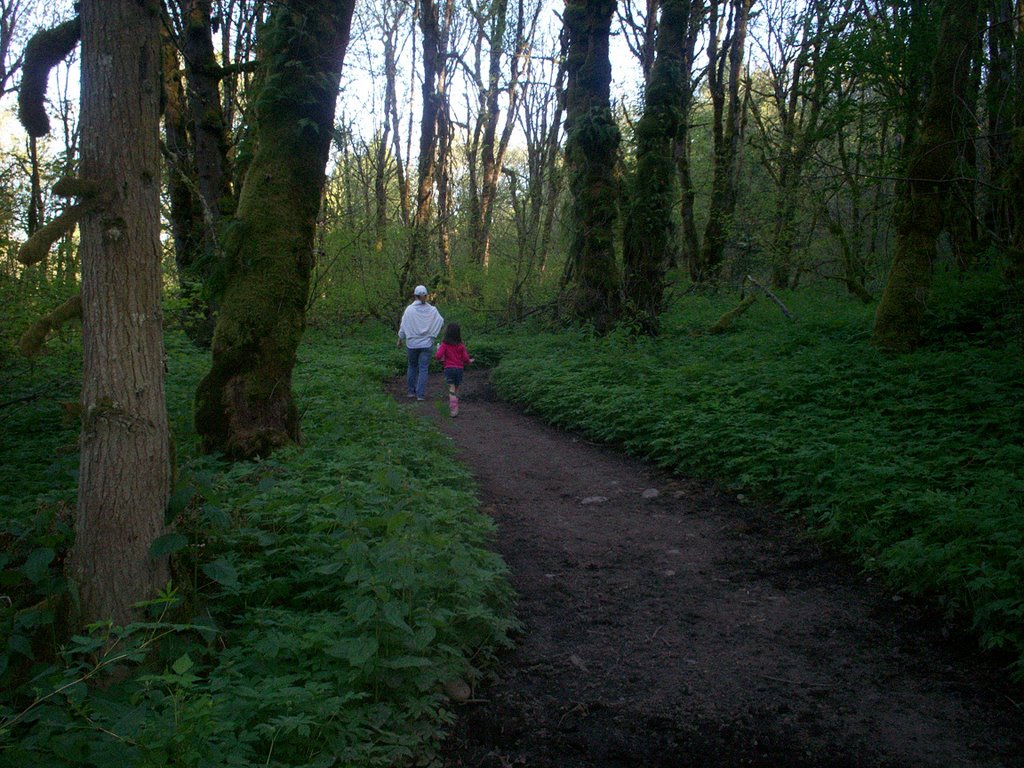
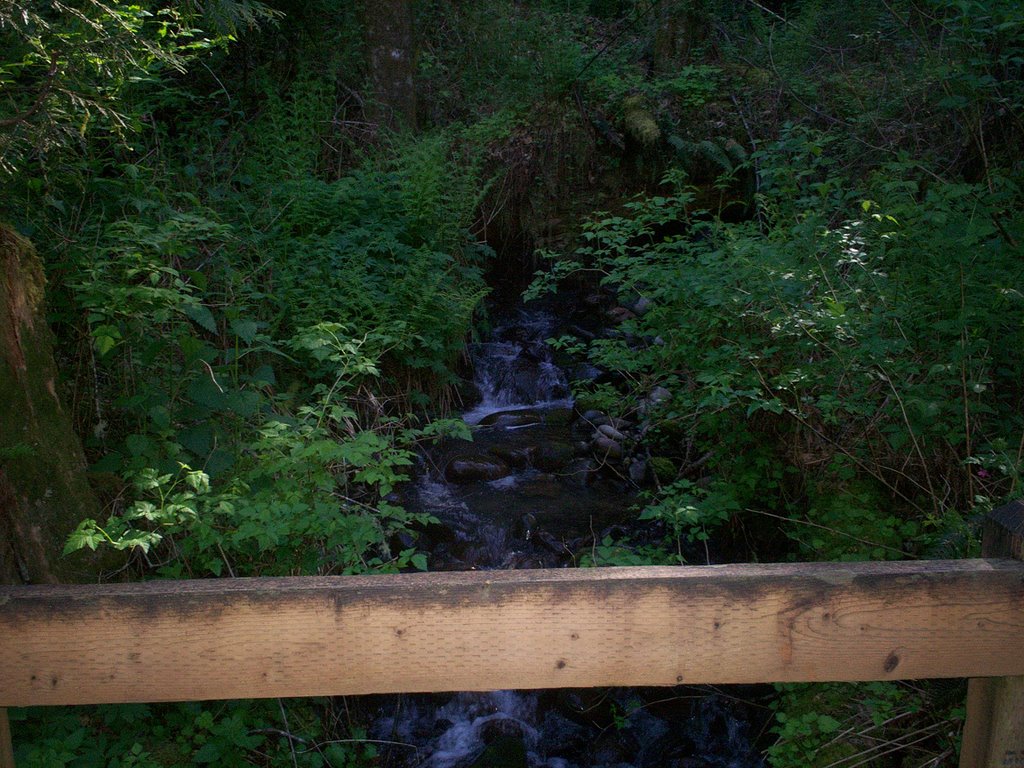
The southeast half contains an overnight campground, horse facilities, a fish hatchery and a great trail that hikers share with horses. It was this side of the park that we spent the day and took these pictures.


We started at the hatchery, which breeds Steelhead amongst other species. There were only a couple of tanks full of water, and only one of the mini reservoirs, but there was lots of fish in each of them, and the kids liked watching the fish jumping out of the water at the inlet pipe, thinking that it was "upstream."
We found a trail behind the hatchery, but it isn't really obvious where the trail goes without their brochure (so pick one up at the entrance to the park). We ended up taking a short spur down to the river, which was nice, but not what we wanted to do. We backtracked and tried again in the other direction and eventually found the trail we were looking for.
The trail you share with horses, so it's really wide, but has lots of mud pits if it's rained recently. It climbs up gradually onto the terrace through mixed forests of Douglas-fir and Alder and Maple. It's really a very pretty walk, and when you get to the top there's a great overlook that gives you views of the river and mountains beyond.
The trail then curves into a wide meadow close to the entrance, where we saw deer on the drive out later. It then continues on across the road and down the southeastern side of the park. We, however, were losing daylight. So we walked down the road back to the car.

Milo McIver was a member of, and the Chairman of, the Oregon Highway Commission from 1950 to 1962, which I guess is an extraordinary length of tenure for a highway Commissioner. Anyway, I find no other excuse for him being given the honor of having a state park named after him, so there you go. Usually, if you are the Chairman of the Highway Commission, you get roads or bridges named after you, like Glenn Jackson (I205 over the Columbia). Here's a page of pictures of ex-Highway commission guys. You have to scroll down to see McIver.

This was a great park, and our family will be sure to get back there and try the other trails, as well as the frisbee golf course, at a later date.

Andijon Massacre Anniversary

I paid lots of attention to the happenings in the region of Uzbekistan last year when a protest of the regime of President Karimov was brutally suppressed by the Uzbek police and military. I even wrote quite a few long posts on the history and geography of Central Asia, just to get perspective (which at the moment I can't find). It was looking like perhaps it would be another colored revolution, like we had just read about in the Ukraine, Georgia and Lebanon.
However, things don't seem to have changed much.

"You see, no one [in Uzbekistan] will mark May 13,"” Razzakov says. "“Quite the opposite. [Authorities] have begun holding concerts of Andijon performers in the stadium. They want to brainwash the youth [and] the people, and turn a day of sorrow into a holiday."”

Israiljon Kholdarov, the chairman of the Erk party'’s chapter in Andijon Province, is another recent arrival in Kyrgyzstan. He says authorities in Andijon have warned relatives of those killed last year to limit traditional ceremonies for the dead to strictly private affairs.

"According to Uzbek custom, there is a wake on the first anniversary of a relative'’s death,"” Kholdarov says. "There are two [security-service] officers and one militiaman outside the homes of every family in which a relative died [last year in Andijon]. They are telling the families not to invite people to [mark] the anniversary, and the mahalla [neighborhood] leaders are supporting it."

In fact they seem to be mired in the oligarchy of a post-soviet satellite, complete with petty dictator. There are still many protests occuring in Uzbekistan and around the world. Amnesty International is going postal on them. But at this stage in the game, and the cooling of U.S. pressure on most international fronts where oppression is occurring, I'm not sure what else is to be done here. Call your Senator I guess. Harass them on yet another issue they aren't dealing with.
Registan has a superlative roundup of stuff on the anniversary of the Andijon massacres.

Taking the Liberal test

"All the cool kids are doing it." Yeah, I've heard that one before. Anyway, someone came up with this fun "Are you a liberal" quiz, which some of the big opinion bloggers out there are taking. The libertarians are lining up opposed to all but a couple of the questions.
The Mudville Gazette notes that the subjects listed in the quiz and the term "liberal" are a direct result of Rush Limbaugh speaking derisively all those years about the political left. I'll admit that the word, in its most classic form, has been bastardized quite a bit. I've always had a thing about not using it to describe the political left, preferring it to refer to actual libertarians, you know. However, terminology does tend to change in the cultural lexicon over time and words that once meant one thing now mean another. And so now all political persuasions seem to refer to the far left side of the spectrum as "liberals." So what are you going to do?
As for taking the test myself... have you read my blog? Duh!

Saturday, May 13, 2006

International Migratory Bird Day Festival

Bet you didn't know about that, did you? Well it was, or is. Every second Saturday of May, apparently, is IMB day. And Portland Celebrates it at Oaks Bottom Wildlife Refuge and Selwood Park.


Basically this is a great thing to do with your kids, or your inner kid if you've ever thought about getting into birds at all. Really it's quite cool. Trained naturalists from US Fish and Wildlife will take you on tours of the Bottom for about an hour, telling you about the many birds that you can see and hear. Ours brought a giant scope so we could see some of them closer up, and some things we would never have seen on our own. The kids enjoyed this part.

On our short tour, we heard many birds like songbirds and finches, but saw many more types, such as Mallard and Wood ducks, Blue Herons, Snowy Egrets, Ospreys, a Green Heron, and my personal favorite: Red Winged Blackbirds. We also spotted a turtle of unknown species (the naturalists didn't have time to scope it) resting on a log before dropping into the water. We were told that there are snapping turtles there as well.
Funny thing was, the wildest sounding animals in the park were the screaming 14 year olds on the roller coaster over at Oaks Park. The wetland is right next to Portland's one and only permanent amusement park, but it doesn't seem to bother the birds all that much. Just those of us trying to listen for the birds.
Once back up in Selwood park, there were many booths where the kids could do stuff like paint a bird, match clawed feet up with the bird species, take apart and examine owl pellets for the bones of some small rodent (popular tent), make an old fashioned pine-cone and peanut butter bird feeder, and actually make a bird house. That last one was the most popular, as the festival provided pre-cut boards, hammers and nails and showed the kids how to do it right there.
The Audubon Society were there showing off a couple of their birds. A peregrine Falcon and a Spotted Owl.


As a part of my continued mission to blogging Oregon's open spaces, I found this a worthy candidate. Portland has many unique parks, and if you're a bird watcher there's probably no better place to bring out and dust off the old binoculars than Oaks Bottom. There's a good long trail that you can start either at the top in Selwood park, or drive down to Oaks Park itself and instead of becoming one of the screaming masses in the amusement park, you can walk under the old railroad tracks and walk around the lake and marshes.

Friday, May 12, 2006

Bush's Progressive Tax Cuts

Hat tip to Instapundit.  Here’s the Joint Economic Committee’s report on the most recent tax cuts.  The bottom 50% of all tax payers pay about 3.46% of the total personal income taxes collected by the federal government.

      The IRS data illustrate the steeply progressive nature of the federal income tax.  Further, data on the number of non-filers, tax shares and the number of taxpayers effectively paying zero federal income taxes must be considered before any valid distributional evaluation of various income tax proposals or legislation can be made.

There you have it, folks.  So when you hear someone complain that Bush’s tax cuts benefited the top income earners the most, there is a reason why.  It’s because there’s not much left to cut from what the bottom half of all taxpayers have to pay.  According to this data, the tax structure is about as progressive as it ever has been.

Anyone else out there think Bush isn’t a political moderate?

Wednesday, May 10, 2006

The ultimate hike!

Spring is here, and the weather here in Oregon is as good as it gets. High 60s and 70s and blue skies. We had a lot of rain this year, and it's nice to feel the sun right about now. This is the time of year when my primal urges for skiing give way to my addiction for hiking. It is that which inspired me to photo blog as much as I can on Oregon's open spaces. Wildernesses and parks.
But this is also the time of year when the hikers, known in the world of hiking as "thru-hikers" start their incredible journeys across vast portions of the United States. They are dedicated walkers, making the decision to walk with their homes on their backs for several months out of the year.
They are called Thru-Hikers because they hike long trails in their entirety. The Appalachian Trail, from Georgia to Maine. The Continental Divide Trail from Canada in Glacier National Park to the Mexican Border in New Mexico. And the Pacific Crest Trail from the Mexican Border in Campo, California, to the Canadian border in the Cascade Mountains of Washington.
You might think these people are nuts, but I understand their desire to put life on hold and experience the freedom of not worrying about anything but what your are going to eat next and where you are going to lay your head that night.
For me, I understand it as the indescribable urge to follow the path and find out where it leads.

The Pacific Crest Trail (PCT) is 2655 miles long, and takes most people who complete it about four and a half months to complete. You can take as much as five, but the window for completing the entire trail is short, as you must wait for the snow to melt in the high Sierra in California and get through Washington before the snow hits there in the fall.
You have to have some serious time on your hands to undertake this, and an intense dedication to the task. Many of the hikers are young and unmarried without children. Some work two jobs in the winter just to afford to take the entire summer off. Some are older and retired. Some are boomers who have a healthy income from investments or work consulting and can afford to take off for just one adventure of a lifetime.


Well before I knew about blogs, I knew about this site called Trail Journals. They allow these hikers to have space to share their journals with everyone, including some of the amazing pictures they bring back. You'll note if you go to the journals section that there are many more than just the three trails that I described above. The PCT, AT and CDT are the big three, but there are many more adventures for those without the time to take on those monumental hikes. The Long Trail in Vermont. The Colorado trail (which mirrors the CDT for much of its length). The John Muir trail through the Sierra. The Idaho State Centennial trail, and many more.
Someday I hope to try the PCT for myself. Perhaps I'll get to sooner if the kids, when they get older, are up to the feat of joining me. My wife is certainly in. But I expect I'll have to get the buggers all up and out to college first. Until then, I've got the mountains and brief interludes during the summers to come. And I've got Trail Journals.com to keep me inspired until then.

Tuesday, May 09, 2006

Where Islam is

not anti-western. A couple of good examples to show that not all Muslim countries are out to get us or cause general trouble. Or harbor terrorists.
Morocco has been campaining against radical Islamicists ever since 9/11.
They helped mobilize more than one million Moroccans to take to the streets of Casablanca in May 2003 to denounce radical Islamic terrorism'—a march in which 1,000 Moroccan Jews openly participated and were warmly embraced by the Muslim community. They launched a theological training program for Imams to teach them how to promote moderation within Islam, to teach them more about Western history and the importance of Christianity and Judaism to Western social and political development, and to help them identify and oppose extremist forces and trends within Islam. Participants take 32 hours of instruction per week for a full year. The first class of 210 just graduated, and included 55 women.

Among other things. I've only copied the tip of theicebergg in that story. Read the whole thing and be encouraged. Certainly, Morocco isn't a bastion of Democracy and tolerance. Christians still find it difficult to reach out there. But the tolerance they do show stands out in the region.
Hat tip to Instapundit for that one.

Perhaps you'd like to notice the past few years in Indonesia.
One, Indonesia is a Muslim country and unfortunately, that sometimes conjures up the belief that it is widely Islamofascist. This really isn't true. Only a tiny number of people subscribe to Islamofascism - when I was in Indonesia, I had to go looking hard for them, because nobody liked it. Most Indonesians, instead, are syncretic, a combination of their own religions - a layering of Muslim, Buddhist, Hindu, Christian and animist tradition - the evidence is below in the pictures. Two, Amid all this very slow moving traditionalism, Indonesia is a real and true democracy. Despite the country'’s reputation for corruption, this country has serious, pro-democracy voters as any in the world. They have give and take. They forgive their enemies. They compromise. They talk to each other, even if they are on other sides of the fence. These are significantly critical elements for making a democracy work.
He has some great pictures of peoples and the volcano, Mount Merapi.

I invented the Smiley Face!

OK, this is just nuts.  I can’t see how anyone at the Dept of U.S. Patents would ever give this one away.

      Wal-Mart is embroiled in a legal dispute over the smiley face image which it wants to trademark in the US.
      A Frenchman who claims to have invented the yellow smiley face back in 1968 is opposing the US retail giant's move.

How can anyone in their right mind think that they own the smiley face?  A character that has probably been drawn by children since the beginning of time, really.

As you read the article and feelings of enmity begin to develop toward Wal-Mart, consider that their spokesman noted that they had no intention of cornering the rights to the happy sketch until the obnoxious Frenchman made moves like he was going to try and patent it here in the U.S.  Greed.  Nothing but greed.

Monday, May 08, 2006

?revolution?

A.M. Mora y Leon has been discussing the relationship between Venezuela and Bolivia. Now that Evo Morales, the super leftist, has taken power as the President of that poor country, he has decided that any and all of the natural resources are now under state control. Leon doubts that there was direct collusion between Chavez and Morales on this move, as it was thugish and very un-Hugo like. However, he speculates that Morales wants to be just like his buddies, Chavez and Castro.
Meanwhile, later Leon declares that Chavez really wants to rule the world, and notes that Venezuela sent over some auditors from the state run oil company to audit the gas companies that Evo just nationalized. Leon notes that "Boli points out that thereÂ’s something distinctly unsavory about the auditors of ONE country, coming down to audit the books of COMPETITOR! When has that ever happened except in a hostile takeover?"

Meanwhile, Hugo's got his own problems, as running a fascist, but caring, socialist dictatorship eventually means that you run your country down to pencil shavings, crime could be the thing that brings Chavez down. His economics have already driven the country to the point where they aren't producing much any more. Products that are made in Venezuela are hard to procure. Their #1 export, oil, is drying up.

Also, be sure to read Lee Harris' article over at TCS on why leftist socialism doesn't seem to want to lay down and die in these pretty third world places.

Excuse Me

You'll all have to excuse me for not blogging in the last few days. As you'll see below, I had a few ready, but mistakenly posted them to my other blog, which I use for professional musings.
Weekend sized brain fart for sure.

Are We At War?

Callimachus writes about the movie "Flight 93" and then discusses how the movie, and the critical commentary from all sides about the movie, describes how Americans view the world today. Then he notes...
The main difference among Americans today is that some of us believe the United States is at war, a dangerous war against a desperate enemy. And other people don't believe that's true at all. To the non-believers, the people who are waging war look insanely violent, paranoid, and unstable. To the people at war, it takes great mental effort to look at those who don't believe it and not see appeasers and useful idiots, if not outright traitors.
Now, I don't think this is entirely true, as there are many other issues that define how we think and believe. But in the last few years the issue of how the Middle East and certain groups of people around the world hold our future for ransom does seem to define a split in the American conscience.
He also makes a point of saying that this is larger than just a like/hate Bush issue. This is beyond Bush, in the end he won't matter. It's perfectly fine to criticize how he is conducting things, as long as it's constructive criticism. However, it's another thing entirely to miss the point and refuse to see that there is a conflict over the future of our civilization.

Musings of a lone blogger

The vast majority of blogs have low readership now, and by that I mean in the dozens. I'’m not trying to demean those blogs; they are obviously important to their authors and readers. But the vast majority of readers, as well as the ad money that blogs will increasingly generate, will continue to revolve around fairly few blogs.
Writes Donald Sensing, who is now writing for Winds of Change, and has given up on his own blog where he has written for years. Which I suppose is my gain, as I read WOC often, but haven't really had the time to read Sensing's own site for a while.
Sensing writes about a subject that I've been hearing a lot about lately. Single writer blogs that have a national or international focus, but want a large readership, are going to find it increasingly difficult to maintain that readership and try to have a life at the same time. If you are not writing constantly, readership falls. But sometimes you just want to take a break. Thus enters the group blog.
Winds has been a group blog for some time, and there are others. But Sensing throwing in the towel is telling that the readership of major blogs is narrowing. What does the future hold for the blogosphere? Will it evolve into something resembling traditional media, with only a few players, and Glenn Reynolds' "Army of Davids" relegated to a much less influential sideline?

Which has gotten me thinking about this site, and what the future is here. I have had visions of being well read, and of improving my writing skills to that end. But I don't think that I can keep up with current events all the time, and write all the time either. Anyone spending more that a few minutes here from time to time is bound to notice that I take significant breaks from writing, several days sometimes. When I get busy, my priorities lie elsewhere.
However I still like that I have a medium that I can write and, in a way, get published. I guess one of the questions I have to ask myself is: do I really need the readership? Should I expect that I'm writing for people, or use this site to just express myself, more like a diary?
The other question I've been asking a lot lately is: what format should I be writing going into the future. I enjoy reading and writing about politics and world events, but for the most part, that stuff exists elsewhere. Heck, everywhere. Am I just adding to the ubiquitousness of political thought, aproverbiall drop in the ocean.
Or do I spend more time writing about local stuff, and talking about places that I've actually been. Taking some pictures along the way, like I've done in the past.

To that end, expect some more photo blogging of Oregon's open areas this summer. My wife and I want to get out more this summer than we have in the past, and since we finally entered the digital photography age by purchasing our first dig camera, we'll be able to share some of that with the rest of the world. Or whoever bumps into this blog.
And yes, I'll still be commenting on other stuff. I just can't keep my mouth shut forever, you know.

BioEthics and the Culture of Death

Joe Katzman relates this story, being followed by John Hawkins, about a woman named Andrea Clark in Houston, Texas, who has a bit of a problem.
She (Andrea's sister) told me that her sister recently had surgery for a heart condition. After surgery, she developed an infection and that's why she's so weak and needs a respirator to breathe. Again, her sister is not brain damaged, she can speak, and she does not want the hospital to let her die.
And yet that's what the hospital is doing. Enter the frustrating story of a woman, mother of a 23 year old man, who entered the hospital to have heart surgery, only to suffer an infection and other complications and have to remain there hooked up to a respirator and a dialysis machine.
From the sister:
The hospital ethics committee met the day before yesterday and concluded that Andrea's treatment (respirator and dialysis) should be discontinued. We have ten days to move her from that hospital or they will "pull the plug" and let Andrea die. Andrea, until a few days ago, when the physicians decided to increase her pain medication and anesthetize her into unconsciousness, was fully able to make her own medical decisions and had decided that she wanted life saving treatment until she dies naturally.
I.E. this is definitely not a Terry Schiavo case. Even in that case, it was the closest family member, the husband, making the decision to stop the machines. Here, for some reason, the hospital has the decision? People are starting the speculate that it's the insurance money that's causing the hospital to act in this way. And it's definitely not the "ethical, compassionate and quality care" that the hospital claims its mission is.

At this point I don't know what a lonely blogger like me can do about this. They are planning protests, and the media in Houston has latched on to the story, so I guess it's only a matter of time until the rest of the country knows what's going on.
The lawyer for Andrea has been trying to fight the hospital or find her a new one, but has run into roadblock after roadblock.
"Okay, I can't stand this anymore. First, we have tried facilities offering every conceivable level of care. She is on a respirator and getting dialysis. There are some nursing homes that offer respirator care and no dialysis and vice versa. The long term acute care facilities see that the hospital says she is "futile" and say they can't take her because they are there to rehabilitate and send patients to a lower continuum of care. Other hospitals rely on the "futility" diagnosis. A provider won't take a patient just on the say so of the family--they talk to the hospital. The hospital believes she is futile. It's a catch-22."
Oh, wait, that's not all. Then there's this:
Moreover, disturbingly, according to Ms. Childers there is a doctor at St. Luke's Episcopal Hospital who has examined her sister and said that he thinks she has a chance to recover. Imagine that, folks -- being sick, having the odds against you, but wanting to fight for your life -- and having the hospital that's treating you cut you off at the knees when you're at your most vulnerable.
So there's some dispute as to her condition, and the hospital thinks it's OK to make the decision to cut off support? Where's the ethics in that? Where is the AMA is all of this? When do we see state legislators and the governor speak up?
Katzman thinks that it's because of insurance that the priorities of doctors and medical facilities have shifted away from 100% patient needs to divided loyalties between patient needs and just how much they can provide.

TAANSTAFL, folks. There Ain't No Such Thing As a Free Lunch. The upside of third-party provided health care is that more people can receive treatment. The downside is that there is a price, and one part of that price is loss of control over that treatment.At the end of the day, medical resources have to be allocated somehow. Worse, since we all sicken and die, demand for these services will always outstrip supply. Handing care over to large systems, be they governments or HMOs, inevitably results in the large payers' priorities moving to the fore with respect to health care decisions.

Just keep that in mind the next time you go to the hospital. Or the next time you think that corporate or big government programs are the way to a better life for all of us.

Tuesday, May 02, 2006

Darfur agreement?

Both the Darfur rebels and the government of Sudan are meeting in Nigeria to discuss terms for cease-fire and relative autonomy for the peoples of the region.  The U.S. and Britain and the African Union are trying to mediate a compromise.

      Government officials in Khartoum, Sudan's capital, were taking the line Tuesday that there was nothing more for their side to do. The government has announced its acceptance of the draft peace agreement, but the rebels have so far rejected it, saying their demands on autonomy and representation have not been met.

And I don’t blame them.  If the Darfur rebels don’t get what they are asking for, or anything close to it, why should they agree to a treaty that they can’t trust the government of Sudan to follow through on.  The article points out that both sides have been disrespecting the cease-fire, but one guess as to which side is doing most of the breaking, or at least instigating the problems.  I’m getting tired of news outlets refusing to remind people in the midst of articles like this that it’s not the Darfur or Chadian rebels that started this, but Sudan government backed militants who invaded Darfur and started killing men, women and children indiscriminately.  I have a hard time siding with the government of Sudan on this issue.

      Darfur has been a staging ground for Chadian rebels, who have risen up against the government there. Sudan accuses Chad of supporting Darfur rebels. The violence threatens to escalate: Osama bin Laden last week urged his followers to go to Sudan to fight a proposed U.N. presence.

What we have here, folks, is truly a world war.  Osama wants to make it global in scope and spread the U.S. out as much as possible.  So it remains to be seen if Al-Qaeda and other terrorist organizations are actually still following his lead and if they are how involved other African countries are willing to get into the conflict. 

Light headed trucks

Truly this is ridiculous.

      Nine states have sued the administration of President George W. Bush for lenient automotive fuel economy standards that they say worsen an energy crunch and contribute to air pollution and climate change.

What they are talking about is that the President asked Congress for permission to change the standards that govern what car manufacturers must meet in all cars and trucks.  He changed the standard for SUVs, minivans and trucks so that anything in the Light Truck class (including all the above types) must increase their mpg by 1.9 – to 24.1 mpg. 

So, now forgive me if I’m being daft or missing something, but isn’t that IMPROVING the amount of pollution exhaled by that class of car?  How do you get “At a time when consumers are struggling to pay surging gas prices and the challenge of global climate change has become even more clear, it is unconscionable that the Bush Administration is not requiring greater mileage efficiency for light trucks.”

What??!?!?!  Bush IS requiring greater mileage efficiency for light trucks.  Perhaps it’s not quite enough for these lawyers, though.

The second thing I have to say to that is that any talk about forcing the auto industry to change to make life easier on citizens who are suffering from higher gas prices is horribly misplaced.  That’s what we need: more regulations and restrictions.  If citizens really are feeling the crunch they will modify behavior and car manufacturers will have to respond, via the market, by creating a more efficient car. 

Again, the effect on current automobile use and global warming is still a matter for serious debate, so alarmist use of the “become even more clear” banter is just making this seem like a showboat fest.

The administration insists, later in the article, that it in fact has done it’s homework and this lawsuit will come to nothing.  But I wonder if we’ll hear about that.

Monday, May 01, 2006

Immigration Protest Blogging

Si Se Puede!
Which is what the protesters are chanting downtown. I took a walk in the spring sunshine up to the PSU park blocks to check out the mayhem that threatened to stop traffic all afternoon. The marchers were supposed to gather there for a while and then set off at noon. I started out from here at about 12:15, noting that I saw lots of police officers on bikes, but no marchers.


It appeared that protesters don't keep tight schedules, as they hadn't taken off yet. Turning the corner on the park block, I could hear the chanting of people in microphones trying to rile the crowd up.
They gathered right outside of Smith Hall at PSU. It's a part of the park blocks that has a lot of brickwork. Specifically, the brick walls and raised brick areas are designed for people to sit and for a small band to play or someone to speak to a crowd. There was an hispanic band there, but while I was there a man spoke in Spanish into a mic, saying one or two lines followed by a woman repeating him in English.

The speakers are in this crowd, but
I couldn't see them very well


There were lots of signs, so I looked around and tried to pick out any that didn't have to do with immigration. There were a couple. There was the standard "Impeach Bush" and then another that called Bush and Cheney the "real criminals." That same sign also said, "Real Americans fear Tyrants, not Terrorists."
But most of the signs, 98% of them anyway, were based on the theme: human beings are not illegal. Or some variant. Many were opposing U.S. House Resolution (Rule?) 4437.
There were lots of American flags, almost as many Mexican flags, but I'm sure the U.S. flags outnumbered them. There were a scattering of other flags, and a few guys in Argentina's Futball Jersey.

Mexican flags were plentiful...


...but not nearly as plentiful as American flags


Most of the people there were hispanic. I would say that 5-10 percent were not, being young and fairly hippy looking, but that's not universal either. I saw one guy holding a sign that read "We want a safer Oregon" on what I assumed was a clipboard for gathering signatures. The picture on sign was a Marijuana leaf.
The protesters began marching about 40 minutes behind schedule. It was pretty civil, from what I saw. I heard a couple of policemen talking on a corner about how they were only worried about mayhem if the anarchists showed up. Cesar Chavez was all about non-violent protest. They marched cheerfully, chanting "Si Se Puede!" This was a popular chant for the movement of farm workers started by Cesar Chavez in the late 60s. It expressed their confidence that they could change things and overcome. Ironically, the United Farm Workers Union that Chavez started and fought for was against Illegal Immigration. Agriculture employers would replace the striking farm workers of Chavez's union with undocumented immigrants.

Nice sign, dude! (says: Patriot Axe)

Of all the signs and flags here I was the most surprised to see this one (pictured above). It's the flag of Venezuela. Nice. Wave the flag of probably the most fascist/leftist state in the entire Western Hemisphere. That guy's not even Hispanic, just some punk. Not that you have to be from latin America to participate or show support, but I'm wondering if he had a clue what he was holding in his hand, and what it represents at the moment.
I guess it represents a country where people don't want to be at the present, and thus they are here trying to become citizens.

Instapundit has been linking to protest information today, and reactions. He reports that the attendence isn't what was advertised ahead of time, although I'm not surprised as that's usually the case.
Also, Powerline has said that they are gathering video and pictures of marches nation wide, but I haven't seen it yet.

Saturday, April 29, 2006

Powell Butte Photo Blog

Portland, Oregon, is known by many names. The City of Roses, dedicated to the massive rose garden in Washington park among other things. The City of Bridges, for it's parade of interesting and historic bridges spanning the Willamette River. The City that Works, called so by the city government in an attempt to mirage what they are actually doing or not doing.
But it's also a city of parks. In it's attempt to control growth by increasing the density of the urban area, mostly by decreasing lot sizes, lots of attention and effort is put forth to preserve as much green space as possible, perhaps to counteract the increasing density of people. There are many neighborhood parks, with the well manicured grass and the play structures. Possibly a baseball/softball diamond or two. But there are some major parks that defy that normal urban park design. They are wild, with no manicured grass. No play structures. The object of their existence is to bring a little nature into the city, and at the same time give those of us who enjoy a little hike through the forest and a good view of the mountains and the city a place to roam.
One of these parks is Powell Butte.

Walnut Orchard at the top of Powell Butte

From the park's pamphlet:
Powell Butte's recent history begins with the purchase of the 556 acre Wilson Homestead in 1925 by the City of Portland. The City's early recognition that Powell Butte's location and elevation would be of high value as a water reservoir site was first utilized in the 1960s when two above ground tanks were constructed by Powell Valley Road Water District. This was followed by Portland Water Bureau's completion of a 50 million gallon underground reservoir in 1980, and a 66 inch water transmission line linking Powell Butte to Washington County in 1983.
The park is now about 600 acres, and includes large meadows and dark stands of Douglas Fir and Western Red Cedar, all through which wind miles of trails for hikers, bikers and horse back riders.

The Cougar trail, along with the Cedar Grove
Trail, offer lush forests with huge trees.


Meadows looking at the top of the butte.
The reservoir is barely noticeable.

There are parts of the park that are off limits to humans, for the sake of wildlife. They do get out and about though, so it's possible to see deer, several species of birds, bugs, and reptiles.
You get the full range of meadow and forest plant life too.

One of numerous wildflowers in the forest

East Portland is unique in that it is littered with small dormant volcanoes. These small mountains perk up several hundred feet above the surrounding neighborhoods. Many of them have been designated as city parks, such as Mt. Tabor, Rocky Butte and Powell Butte. Powell Butte is a lava dome in a chain of such volcanoes known as the Boring Lava Domes. It is much flatter on top than most of the other volcanoes in the area, and thus the hiking isn't quite as steep.


From the top of the butte you can see in almost all directions, and near the orchard there are some park benches and a circular set of arrows placed in the ground pointing to various features that you can see from there. On a good day (which when these shots were taken, it was pretty hazy) you can see Mt. Hood, Mt. St. Helens and Mt. Jefferson, as well as the city of Gresham and the Columbia Gorge.

If you live in Portland, or are in the area, spend a couple of hours wandering around on the Butte. It's one of the gems of the Portland Park system.

Looking up through the decayed trunk of an old tree


Cedar grove

Friday, April 28, 2006

Michael Totten recalls his visit to Israel.
Arab countries have a certain feel. They'’re masculine, relaxed, worn around the edges, and slightly shady in a Sicilian mobster sort of way. Arabs are wonderfully and disarmingly charming. Israel felt brisk, modern, shiny, and confident. It looked rich, powerful, and explicitly Jewish. I knew I had been away from home a long time when being around Arabs and Muslims felt comfortably normal and Jews seemed exotic. First impression are just that, though. They tend to be crazily out of whack and subject to almost instant revision. Israel, I would soon find out, is a lot more like the Arab and Muslim countries than it appears at first glance. It'’s not at all a little fragment of the West that is somehow weirdly displaced and on the wrong continent. It'’s Middle Eastern to the core, and it has more in common with Lebanon than anywhere else I have been. The politics and the history are different, of course. But once I got settled in Tel Aviv I didn'’t feel like I had ventured far from Beirut at all.
Read the whole thing. My mere words can't express the surprises that Michael would find when talking to an Israeli blogger about life in a country surrounded by people who want to kill them. Or do they?
Then there are those - and they'’re almost completely ignored by the media - who defy these categories completely. The Druze serve in the Israeli Defense Forces. And the Druze are as Arab as anyone else in the region. The biggest problem the Israeli government has with Druze members of the IDF is not that they are not loyal. The biggest problem is that they are consistently the most roguish and brutal toward Palestinians. They speak Arabic as their first language. Palestinians say they are traitors. Bedouin also serve in the Israeli Defense Forces. The skills they learn as desert wanderers make them the perfect trackers. Lisa told me the Bedouin in Egypt'’s Sinai Peninsula speak Hebrew.
There's so much more. You'll never figure out what people are like, or what the sentiment is on the street, from the traditional media. TV, Newspapers, etc. They just don't spend the time to get out there any more. Totten is though, and my view of the middle east is changing with every post I read.

Tuesday, April 25, 2006

Cinderella man vs. The Jewish Icon

Interesting piece from David Adesnik that just goes to show that sometimes there aren't any good guys and bad guys, just regular folk trying to do good.
"THAT ONE'S FOR HITLER" is what Max Baer snarled in his 1933 bout with German boxer Max Schmeling. During that match, and in every match thereafter, Baer wore a Star of David on his trunks. Although raised Catholic, Baer had a Jewish father and, not surprisingly, became a hero to Jews around the world. Baer held the world title for 364 days, from June 13, 1934 until June 12, 1935, when he lost the belt to James J. Braddock, recently made famous by the Hollywood version of his life, Cinderella Man. In the film, Baer is a bloodthirsty hedonist, who attempts to intimidate Braddock by reminding him of how two of Baer's opponents died in the ring. According to film critic David Fellenrath, this portrayal is patently unfair. Although the real life Baer did kill one of his opponents in the ring, he was wracked by guilt thereafter. After the death, Baer went on to lose four of his next six fights and have recurrent nightmares. He also donated some of his winning's to the family of his fallen opponent and later on put his children through college. Mercifully, Cindrella Man never mentions that Baer was a Jewish icon. According to Fellenrath, the careful viewer can spot the Star of David on Baer's trunks, although I didn't notice it while watching the film this evening. In contrast, the Star on Baer's actual trunks was quite noticeable (see above). Although far from bloodthirsty, Baer's was actually a hedonist who didn't take Braddock seriously and barely trained for the fight. According to Baer's son, he even had one of his mistresses pleasure him before the fight -- an apt prelude to Baer's very successful career in show business both during and after his time as a professional fighter. Although it's very hard not to enjoy Cinderella Man, there is a good case to be made that Max Baer should have his own movie. (And so should Max Schmeling, who never wanted to be a Nazi icon and even hid two Jewish boys in his hotel room during Kristallnacht, after which they emigrated to America.)

Birds of a feather

...spread the flu with ever increasing rapidity.
With all the hubbub over the Avian Flu pandemic that is just around the corner, coming to a town near you, it's easy to get caught up in the craze of blaming someone, be it the government or the pharmaceutical companies, for not being ready to deal with this pandemic. But the reasons that we are slow to react might not be what you think.
I linked yesterday to a TCS Daily article by Dr. Henry I. Miller calling for a Manhattan Project for the bird flu, saying that government regulation and lack of financial profitability are hindering scientific progress that could help stop an Avian flu pandemic. There is another piece today at TCS that looks at a similar quelling effect on advances in biotechnology, caused by disregard and disrespect for intellectual property rights.
So instead of insisting that the government get busy and spend spend spend on research for cures and vaccines, it should actually be getting out of the way.
With so much potential in biotech it's no wonder that White is frustrated by the growing trend to violate intellectual property rights. His complaint is similar to Dr. Miller's; when financial incentive is stripped from an enterprise, investment lags, and progress is slowed.
Its not that there shouldn't be limits and agencies that watch for careless research and harmful products. But the weight of the bureaucracy required to get stuff approved is prohibitive. Remember, innovation in the Soviet Union was, for the most part, driven by political forces. Otherwise it would have ground to a halt, and pretty much did anyway in everything except space and Olympic sports.

Hat tip to the Kat's Meow for the links.

Standing room only

Ever since I first took an airplane at some young age, 9 or 10, I can't remember, I've loved flying. I took many trips from my home in Albuquerque to visit my grandmother in Maryland, and my parents would let me go by myself. It was magical, being on your own (with the kindly help of the flight attendants to lead me around) and traveling to new places. Ever since I have enjoyed flying and especially like hanging out in airports. I was sad when deregulation led to airlines reorganizing flights into the hub system to make flying more efficient. No longer would I wait for hours in a strange airport, getting to wander around for a while before my next flight. You're lucky these days if you don't have to run full speed to your connecting flight.
The actual flights were fun to. I loved maps (still do) and almost always got to have a window seat so that I could see the best map there was: the real thing. I read magazines, did logic puzzles.
Flying is a bit different now. No time to peruse airport concourses. Responsibilities at either end of the flight. And I'm a bit bigger now, so the seats are not my favorite place to be. I used to relish 4 hour legs, but now the shorter the better. I just get too cramped in those tiny rows. Jack Bogdanski complains:
Ever since Ronald Reagan ordered the application of the almighty Free Market Principles to the U.S. airline industry, the experience of flying on a commercial jet aircraft has steadily declined in quality. Now you go hours without food, are lucky to get served putrid water, rise at 4 a.m. to make your flight, and endure ticket pricing that defies all logic. "Why should you have to pay for something you don't want?" was the dominant mantra.
That may be, but the relative cost of flying is nothing like it was before Reagan. If you want to pay those prices, you can sure still get that comfort in something they call first class. Most of us are willing to put up with the lower amenities for the relative inexpense of flying great distances in a couple of hours.
Comes news now that Airbus is considering creating sections that are super economy. Persons would stand against a padded board, strapped to the board.
Airbus has been quietly pitching the standing-room-only option to Asian carriers, though none have agreed to it yet. Passengers in the standing section would be propped against a padded backboard, held in place with a harness, according to experts who have seen a proposal.
Holy leg cramps, Batman! My understanding from reading the article is that they are trying to get these on the short hops that Japanese airlines make from island to island. So you'd only be standing for a half an hour or so. That's as long as I stand on the train into work every morning. What a weird feeling that would be to take off and land standing up.
Would I be willing to do it? Maybe on short commuters to Seattle and Spokane. I'm already used to reading and snacking standing up. I would just be trading the cramped and stuffy seats for the leg cramps.

God in the public square

I’ve chimed in here and there about religious issues and secularism in the public square.  Those  on the left side of the aisle continue to berate the religious right for it’s rhetoric and the Bush administration for trying to create a theocracy (as if that were possible in this country), and those on the right continue to scream that they’re under siege and the like.

Recently Newt Gingrich has been promoting some challenges that America must overcome in order to preserve our great nation, including confronting militant Islamists and staying economically competitive with China and India.

But one of them also includes defending God in the public square.   Alan Stewart Carl responds to that.

      Some people like to point to the rise of the Christian Right (better referred to as Christianists) and of false-issues like the “war on Christmas” as proof that we are living in a time of impending theocracy. But that’s just not the case. The Christian Right and their issues (real and invented) are a reaction to the realization that what we are living in is a time of impending hyper-secularism. And while I and many others (possibly Newt himself) regularly and even deeply disagree with the means and rhetoric of the Christianists, we are not particularly pleased with efforts of groups like the ACLU to wipe America clean of public displays of religion.

      And before anyone accidentally or willfully misinterprets my position, I am not calling for the Ten Commandments to be posted in courthouses and creationism to be taught in our schools. What I seek is a nation where we as a people do not get offended when confronted with the religious beliefs and passions of those whose faith seems odd to us. Nor should we get offended when our own religious beliefs and passions are scorned and mocked by others.

      When Gingrich says the future of our nation is reliant on “defending God in the public square” what I think he means is that freedom of religion, all religion, is one of the founding principles of this nation. In our zeal to keep church and state separate, we should be careful not to separate faith from our national character and public life. A man’s religion is not contained in his church or synagogue or mosque or temple—it’s part of his whole life. And America lets him live that religion. Even in the public square. Most importantly, in the public square.

As strikingly moderate and sensible as this is, I think that it’s probably how most people think on this issue, left or right.  You can criticize religious figures who rail on with catchy phrases like “War on Christmas,”  but even more so, organizations like the ACLU have become hopelessly out of touch with the values of the vast majority of Americans.   

Sunday, April 23, 2006

Free Speech?

The 9th Circuit court does it again.
Tyler Harper wore an anti-homosexuality T-shirt to school, apparently responding to a pro-gay-rights event put on at the school by the Gay-Straight Alliance at the school. On the front, the T-shirt said, "Be Ashamed, Our School Embraced What God Has Condemned," and on the back, it said "Homosexuality is Shameful." The principal insisted that Harper take off the T-shirt. Harper sued, claiming this violated his First Amendment rights. Harper's speech is constitutionally unprotected, the Ninth Circuit just ruled today, in an opinion written by Judge Reinhardt and joined by Judge Thomas; Judge Kozinski dissented. According to the majority, "derogatory and injurious remarks directed at students' minority status such as race, religion, and sexual orientation" -- which essentially means expressions of viewpoints that are hostile to certain races, religions, and sexual orientations -- are simply unprotected by the First Amendment in K-12 schools. Such speech, Judge Reinhardt said, violates "the rights of other students" by constituting a "verbal assault[] that may destroy the self-esteem of our most vulnerable teenagers and interfere with their educational development."
Oh, heavens. What are the odds that this WON'T be overturned by the Supreme Court. I realize that schools need a tool to help them stop disruptive behavior, but the dissenting opinion points out that there wasn't much evidence that there was any disruption at all.
What's it going to take for people to get that almost every opinion is going to offend someone, and you can't subvert it just because it's going to do so.

Thursday, April 20, 2006

So what do we call it?

Some people make a pretty big deal out of what exactly to call this military conflict that takes up so much front page space these days.  Those of us who believe that it’s a war tend to call it the “War on Terror” although that’s kind of a nebulous phrase, considering that “Terror” is a battle tactic, not an entity per say.   One could not, for instance, declare war on the blitzkrieg.  Although some might be so bold as to declare war on fascism, which still exists in way too many places.

So what do we call it?  We can’t call it a war on Islam, which would be wrong, as there are millions of rational and relatively peaceful Muslims in the world.  We can’t really declare war on any particular nation state, as the main antagonists don’t really belong to one country or another.  The closest thing we have to an enemy nation state would probably be Iran, but that hasn’t really heated up yet.

Is it a war on Al Qaeda, the terrorist organization?  Perhaps, but I don’t think the administration has any intent on limiting this to one group of people, this is designed to target ANY organization that has designs on using terror against us or anyone else.

Can we call it a war against Islamo-fascism?  Well, fascism does define a right wing oppressive dictatorship, and I guess that’s what Islamic terrorists would have in place had they their way.  But it doesn’t quite cover it.

How about: “Any organized group of individuals who practice a particularly violent variant of Islam that actively works to get their way by terrorizing, bombing or beheading ordinary people, and you know who you are.” 

Jonathan Rauch thinks that we should call it War on Jihadism, but I’m not sure that works either, as Jihad is a part of Islam lore and history that exists for all Muslims. 

Chinese dissidence

Via Instapundit, this Washington Post article discussing a Chinese man arrested for his ideas, and the push to get Bush to address it while Chinese President Hu Jintao visits the United States:

      He personifies a generation of urban Chinese who have flourished thanks to the Communist Party's embrace of market-style capitalism and greater cultural openness. He got his MBA from the University of Michigan and worked for EarthLink before returning to China to pursue his dream of becoming a documentary filmmaker. He and his sister, Nina Wu, who works in finance and lives a comfortable middle-class life in Shanghai, have enjoyed freedoms of expression, travel, lifestyle and career choice that their parents could never have dreamed of. They are proof of how U.S. economic engagement with China has been overwhelmingly good for many Chinese.

      Problem is, the Chinese Dream can be shattered quickly if you step over a line that is not clearly drawn -- a line that is kept deliberately vague and that shifts frequently with the political tides. Those who were told by the Chinese media that they have constitutional and legal rights are painfully disabused of such fantasies when they seek to shed light on social and religious issues the state prefers to keep in the dark. . . . But we have a serious problem that won't go away: How can Americans respect or trust a regime that kidnaps our friends?

Some might argue that the transformation of the Chinese society is slow and painful, and that we should keep on trying to just apply soft political pressure while some Chinese continue to suffer from oppression.  I think this view emphasizes the gains that society has made in that country are a work in progress.  However, the Chinese government instituted those economic changes so that it could stay in power politically, so I’m not sure that, while there is far more economic freedom than there used to be, that the government is in any danger of succumbing to any social pressure to change.

Add to that the U.S. need for China to stay involved in the diplomacy with North Korea and stay on our side in that arena.

Tuesday, April 18, 2006

Cracking down in Europe

For all the huffing and puffing over the NSA program and how Bush is eradicating rights left and right, here’s what Europe is doing.

      Most of Britain's new counterterrorism legislation, which outlaws the vaguely worded "glorification" of terrorism, came into force on Thursday. Italy and the Netherlands have relaxed the conditions under which intelligence services may eavesdrop. French legislation recently gave investigators broader access to telephone and Internet data. German legislation being drawn up seeks to allow intelligence services easier access to bank and car registration records.

The International Herald Tribune frets about harming civil liberties, but Europe’s leaders seem to be more concerned with their citizens’ lives.

Hat tip to Powerline.

Road Trip!

Don’t miss any of Michael Totten’s road trip to Iraq.

      The first time I went there on a day trip from Erbil it seemed like such an innocent place. After seeing the rough hell of Turkish Kurdistan, though, and realizing that the Kurds in Iraq had it even worse under Saddam, it did not seem so innocent to me anymore. Iraqi Kurds struck me as deeply, profoundly, mature. It took so much work, blood, and sacrifice to build what they have. And they built it from nothing.

      Iraq is the only country in the world where Kurds wield any power. They're ground down under the majoritarian boot everywhere else. For the most part they wield their power responsibly. Government corruption is still just atrocious, and they haven’t yet fully emerged from a traditional society into a completely liberal and modern one. A Kurdish journalist was recently thrown in prison after a fifteen minute show trial for blasting the KDP in a newspaper column. He was later released, but he’s not yet out of trouble. The Kurdish quasi-state wants to be liberal, but still doesn’t quite understand how or what that means.

      Even so, they’ve made more progress in the region than anyone else except, perhaps, for the Lebanese and the Israelis. And they started a mere fifteen years ago from the bottom of Saddam’s mass graves. From the Mouth of Hell to…the Utah of the Middle East. By force of sheer will against extraordinarily long odds.

Technology with a human touch

Helping people find best routes at a multi venue event.  At the Commonwealth Games in Melbourne, Australia, volunteers wandered around with small handheld wireless PDAs to help visitors find their way around. 

Basically, what these devices were designed to do was create routes from one event to another.  For instance, if you were at the track and field events, but wanted to get to the swimming and then to a rugby match, but you had never been to Melbourne before, you would find one of these people standing around, and ask them for directions.  They would enter the events you wanted to attend and the information would be processed at a remote server and a map with directions would be returned to the volunteer’s PDA.  Each volunteer had a small black and white printer attached to their belts which would print out the directions, which would include a combination of walking, bus and rail routes to optimize their travel time.

This is a pretty nifty thing, in that instead of having a number of kiosk type stations where people would do this themselves, real live people were, in effect, the kiosk.  I think this has a number of advantages over the kiosk system. 

    1. While kiosks provide information without having to manage the people to run them, having volunteers with wireless devices allows them to override the directions when it makes sense to do so. 
    2. Since there are still a number of people in the world who don’t do well with technology, having live people to get the directions for them improves access to the technology
    3. People always have more questions than any information system can handle, and kiosks can only answer so many of them.  But volunteers who know the ins and outs of the transportation system, the events and the city itself are generally the most efficient information system.

I wonder if this sort of thing is going to be used for the Olympics.
On a side note, I really wasn’t familiar with what the Commonwealth Games are all about, since our media over here pays little attention to them.  In effect, they are like the Olympics, but only for former British colonies.  There are lots of events like that on a regional level, like the Pan Am, Asian and African games.  One fun aspect of that is that all the former members of the British Empire speak English, and so everyone at the event can communicate with each other.   Former host cities have been Manchester, Kuala Lumpur, Victoria (BC), Auckland, Kingston (Jamaica), and the next games in 2010 are in Delhi, India.

Saturday, April 15, 2006

Watch dogging the News

Blogs tend to take a bad wrap from the main stream media. However they do keep the press honest. Take this example recently from the NY Times, where a journalist mis-represented the testimony of FISA judges before the Senate Judiciary Committee regarding Bush's wire tapping.
Powerline had read the transcripts of the testimony, and scrutinized the article in two posts. A publisher of a small newspaper read those posts, called the Times senior editor and pointed out what the transcript actually said.
The Times editor called back and said that he was right, and the correction appeared in a later edition. It's unfortunate that not many people will actually read the correction, and therefore will still have the wrong impression about the authority that Bush has to initiate wire tapping, but at least there is some recognition that a wrong happened. Wonder if the article's writer is going to get talked to or reprimanded in any way.

Thursday, April 13, 2006

Riot in Nepal

Last year, King Gyanendra declared martial law because, as he claimed at the time, he was afraid that communist rebels were a threat to take over the country.   Now, after months of government suppression of any opposition or criticism of the king, the people of Nepal are getting restless.  And violent.

      Police fired rubber bullets and tear gas at hundreds of lawyers protesting against the king's rule as demonstrations and an opposition general strike continued in Nepal for an eighth day Thursday.

      Dozens of lawyers were wounded after police hit them with batons, and at least 70 were arrested, said Madhav Baskota, general secretary of the Nepal Bar Association. Two lawyers were hit with rubber bullets and one by a tear gas canister, he said.

      Later, a crowd of thousands calling for the king to resign marched on a road where demonstrations are prohibited. Police kept watch but did not interfere.

      "People and police come together! Hang King Gyanendra!" the protesters chanted.

Wow.  It’s nuts over there.  The king relaxed some restrictions regarding cell phone usage and night curfews, but I doubt that’s going to tame the beast.  Now, the communist rebellion is still out there, and they certainly are a threat, but there is uncertainty of what would happen if the people decided that they needed to forcefully extract the king from the seat of power.  Would sane people be a part of whatever new government fills the void?  Or would the communists be in position to take the reigns? 

The US State Department is pulling Americans out of the country now.  They should also be warning Gyanendra that if he doesn’t ease up on his people, he could be setting the stage for something far worse than what he is trying to prevent by cracking down.

Wednesday, April 12, 2006

The Future of Mt. Hood Recreation

The three ski areas on Mt. Hood have been envisioning what their future might look like.  With the Mt Hood Stewardship Legacy Act being debated in Congress, Reps Blumenauer and Walden asked ALL interested parties with a stake in what happens on the mountain to submit a wish list of things that they think would improve access and the mountain’s resources. 

Most of what the ski area’s asked for didn’t make it into the bill.  Not surprising, given what they were asking for.

      Mount Hood resort operators hope skiers someday can park their cars at huge parking lots before reaching Government Camp and then ride a shuttle bus or aerial cable car connecting the three major ski areas.

      Truck drivers hauling goods from Portland to the east side of the Cascades might take a new road through Clackamas County forests connecting Oregon 224 to U.S. 26, avoiding today's skier-caused traffic jams at Government Camp.

      Among other things, the agreement supports widening highways, building sewage treatment systems, using stream water for snowmaking, developing land for housing and parking lots, and implementing a collective marketing strategy that includes the U.S. Forest Service.

So I read that and my eyes perk up.  A cable car?
The Legacy Act under discussion creates about 70k acres of wilderness in the Mt. Hood national forest, as well as settles a lawsuit regarding land in a watershed that the Mt. Hood Meadows ski area has rights to develop.  The agreement swaps the land with some land in Government Camp that’s OK to develop.

But the bill also calls for a study…

      The bill also calls for a study of a gondola running between Government Camp and Timberline Lodge. The idea, also part of the wish list, would run a cable car in roughly the same line as an aerial tram that existed in the 1950s but was closed after a couple of seasons when the road leading to Timberline Lodge from U.S. 26 was improved.

What they are saying in the article is that this gondola system would also connect Timberline with Mt. Hood Meadows, running over the White River canyon.  What would that mean?  One ticket for both ski areas?  It wouldn’t be out of the question, lots of ski areas around the world, and in the US, have grown together to form larger areas.  Some just share tickets, even though they aren’t actually connected.  What I want to see is a season pass or 10 time pass that’s good at all three ski areas.  Even if they aren’t linked.

Back to the White River canyon.

      Meadows, for example, would have to amend its 1997 master plan that prohibits developed recreation in the White River drainage.

      The ski areas could be setting themselves up for a huge fight. White River is considered an important wetland and wildlife corridor, and it's one of the most accessible and popular high-alpine environments for backcountry skiers, snowshoers and summer hikers.

And I’m one of those hikers.  Although I don’t think it would kill people to have a gondola line there.  Really this is about the aesthetics more than anything.  As long as there aren’t any towers in the canyon, which I think is doable, you aren’t going to mess with wildlife or hikers.  And really – a wetland?  Have these people been in that canyon in the summer?  Nothing but sand and boulders, interrupted only by the channel of the White River.

They also talk in the article about a traffic relief corridor running from Highway 224 to the east side of the Cascades.

      The highest priorities for the ski areas are the expansion of U.S. 26, creating a bypass from Oregon 224, and building mass transportation hubs that could put skiers in buses and take traffic off the highways.

I’m not sure where they would build it.  They are correct, that building another highway to Bend would definitely reduce traffic on the 26.  But it’s going to increase traffic on a portion of the forest that’s never seen more than a handful of cars on any given day.

The ski areas haven’t changed all that much since I started skiing there over 15 years ago.  The officials involved are right that the future could get a lot more dismal, traffic wise, if they don’t start planning now.

The Westlund Effect

Latest polls regarding the Oregon Governor’s race next November tell and interesting tale.  Wall Street/Zogby did a poll showing how any of the candidates would do against any of the other candidates in a general election (i.e. places all the Democrat hopefuls against each Republican and sees how they will do). 

The interesting thing is not that any of the Democrats would easily beat any of the Republicans on the docket.  The weird thing is how Ben Westlund influences the race.  Remember, he’s a former Republican turned Independent for this governor race.

But his numbers don’t bring down the Republican numbers, they bring down the Democrat numbers, bringing them into a dead heat with each Republican for all possible scenarios.

I’d sign the petition for this guy to get on the ballot, but some stingy law in Oregon prevents me from doing so unless I re-register as an independent, or else not vote in the May primary AT ALL.  How dumb is that?

Happy Birthday Beverly

Beverly Cleary turned 90 years old today.  Her books for kids about Ramona and Henry all occur in the area of Grant High School in Portland where she graduated.  My kids have played in the fountain in Grant Park that has copper statues of Henry, Ribsy (his dog) and Ramona the Pest.  The Hollywood/Alameda hill area is one of my favorite in Portland.  Thank you Ms. Cleary, for all the great stories.

Monday, April 10, 2006

Life in Hell

Or close to it. This is a closer look into Venezuela, where fear permeates every level of society, from rich to poor. Fear of the cops.
The anger is cutting across class lines, because kidnapping, robbery and murder affect rich and poor alike. This is the first event ever thatÂ’s united rich and poor in Venezuela. The shantytowns of Caracas are some of the most dangerous places on earth. The wealthy and middle class, meanwhile, are regular targets of opportunity for the same thieves and extorters and kidnappers and killers. ItÂ’s mostly cops doing it, the very officials who are supposed to protect the people. The cops, to remind the people that they donÂ’t see protecting them as in their interest, have actually shot into a protesting crowd and killed a photographer, completely validating the crowdÂ’s anger at the police.

With lots of links to other info and testimonies.